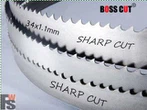
The choice between HSS and carbide tipped saw blades should be driven by process conditions, workpiece characteristics, and production economics. Below is a structured decision framework.
Preferred Applications for HSS Blades:
Complex geometries and low rigidity workpieces – HSS exhibits superior fracture toughness and resistance to lateral bending, making it suitable for cutting gear blanks, structural shapes, and thin-walled tubular sections where vibration and deflection are concerns.
Mixed-material and intermittent cutting – In job-shop environments involving varying grades of steel, non-ferrous metals, or stacked materials, HSS offers adequate wear resistance without the brittleness risk associated with carbide.
Low-volume roughing or contingency operations – For small-batch production, maintenance repairs, or emergency tear-downs, HSS provides a cost-effective solution with on-machine re-sharpening capability and lower replacement cost per blade.
Conditions Where Carbide-Tipped Blades Are Mandatory:
High-hardness materials – Workpieces with a Brinell hardness ≥300 HB (e.g., quenched and tempered steels, bearing races) will rapidly induce thermal softening and flank wear in HSS; carbide's hot hardness and compressive strength are essential.
Heavy-section continuous cutting – For stock thickness exceeding 50 mm in uninterrupted production feeds, HSS suffers from inadequate thermal conductivity, leading to localized overheating, blade warpage, and premature tooth failure. Carbide's higher red hardness ensures stable cutting temperatures.
High-precision finishing – When dimensional tolerances are below ±0.05 mm or surface finish requirements are stringent, carbide's superior elastic modulus and damping characteristics minimize tool deflection and chatter, delivering repeatable geometric accuracy.
Economic Consideration: While carbide blades command a higher initial investment, their extended tool life (typically 5–10× that of HSS) and higher permissible cutting speeds often reduce per-part tooling costs in high-volume runs. Conversely, HSS remains economically advantageous for low-utilization or prototype operations where capital expenditure must be contained.
Final Recommendation: Base your selection on a triage of material hardness, section thickness, batch volume, and tolerance class-not on blade price alone. When in doubt, a conservative approach is to assess thermal load and rigidity demand first; these two factors alone will lead you to the correct choice in over 80% of cases.