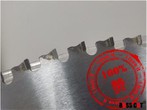
Band saw blade is a cutting tool in metal processing. It is often used in various industries such as automobile and spare parts manufacturing, machining, aerospace and nuclear power. According to different raw materials, it is divided into bimetal band saw blades and carbide. Band saw blade. Next, the editor will take the bimetal band saw blade as an example to introduce the common specifications and models of the band saw blade.
1. Description of the length of the band saw blade (coil length or root belt length):
The length of the root band of the band saw blade is determined by the sawing machine we use. Manufacturers can customize according to customer needs.
Common rib specifications product specifications are:
13mm---30m/disk 41mm----75m/disk
19mm---100m/disk 54mm----55m/disk
27mm---100m/disk 67mm----55m/disk
34mm---85m/disk
2. Common specifications of bimetal band saw blades:
Band saw blades are industrial consumables and need to be used with band sawing machines. The commonly used specifications and models are:
13mm*0.65mm, 13mm*0.90mm, 19mm*0.90mm, 27mm*0.9mm, 34mm*1.10mm, 41mm*1.30mm, 54mm*1.30mm, 54mm*1.60mm, 67mm*1.60mm, 80mm*1.60mm.
The specifications here mainly indicate width*thickness, and the complete model also includes tooth pitch. For example, the specifications on the band saw blade are written as 41*1.3-1.4/2.0TPI, 41 is the width, 1.3 is the thickness, and 1.4/2.0 is the tooth pitch.
1. The width and thickness are basically fixed. Taking Taijia's bimetallic band saw blade as an example, it is the above ten types.
2. The sawtooth form is divided into equal pitch and variable pitch
Equal pitch is common: 4, 6, 14
Common variable pitches are: 0.75/1.25, 1.0/1.5, 1.4/2, 2/3, 3/4, 4/6, 5/8, 6/10, 8/12, 10/14, 14/18 ;
3. The TPI value (pitch) increases, although the single tooth cutting depth and force are increased, but the overall cutting force and feed force can be reduced, which is beneficial to avoid the occurrence of inclined cutting failure.
4. The reduction of the TPI value (pitch) reduces the single tooth depth of cut, which is beneficial to prolong the wear life of the saw blade, but it will increase the cutting force and feed force, which is not conducive to ensuring the cutting verticality.